A Persistent Ni(0)–Pentalene Complex with High Fluxionality: Does Stronger Antiaromaticity Promote Metal–Ligand Interactions?
Riina Kuwata, Takefumi Imanishi, Shota Hasegawa, Zhe Wang, Junichi Usuba, Kosuke Yasui, Muhammad Usama Gul Khan, Judy I. Wu*, Yuta Uetake*, and Aiko Fukazawa*
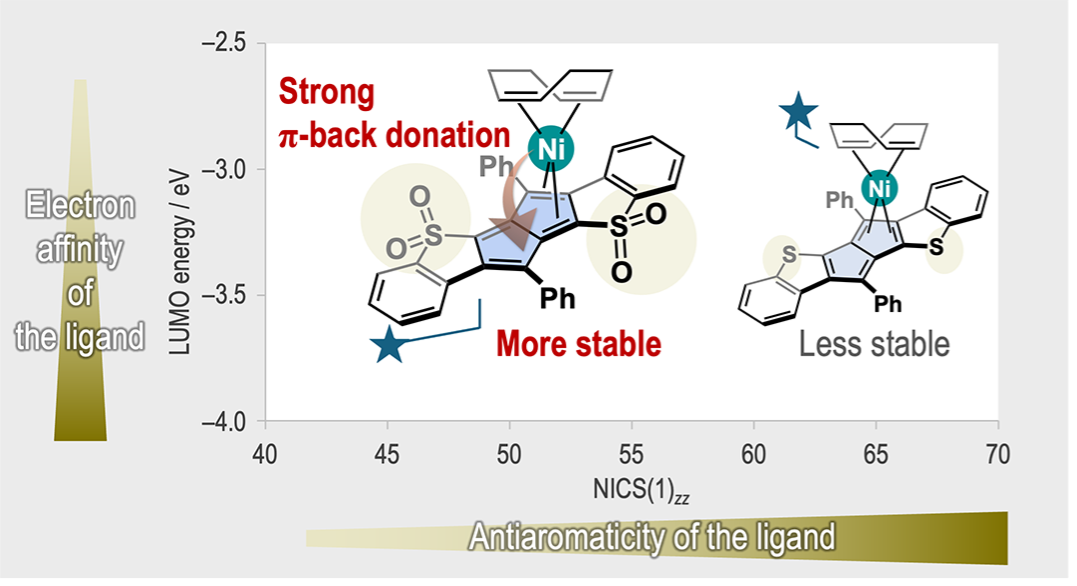
Despite the long-standing use of transition metal complexation for stabilizing antiaromatic hydrocarbons, the underlying factors that govern their coordination behavior remain unclear. A Ni(0) complex, [Ni(cod)(1)], featuring a benzothiophene-S,S-dioxide-fused pen-talene ligand, was synthesized and characterized, and compared to a benzothiophene-fused analog, [Ni(cod)(2)], which bears a more antiaromatic yet less electron-accepting pentalene ligand. Single-crystal X-ray diffraction, X-ray absorption spectroscopy, and variable-temperature NMR, combined with computational analyses, reveal that the enhanced stability of [Ni(cod)(1)] arises primarily from sub-stantial π-back donation facilitated by strongly electron-withdrawing SO2 groups that lower the LUMO energy of 1. Comparisons to [Ni(cod)(2)] further demonstrate that a more antiaromatic core does not necessarily lead to stronger coordination to the Ni center. Surprisingly, the robust [Ni(cod)(1)] complex is fluxional in solution; the Ni center migrates reversibly between the two five-membered rings of the pentalene ligand via a bond shift mechanism.
@article{kuwata2026a,title={A Persistent Ni(0)–Pentalene Complex with High Fluxionality: Does Stronger Antiaromaticity Promote Metal–Ligand Interactions?},author={Kuwata, Riina and Imanishi, Takefumi and Hasegawa, Shota and Wang, Zhe and Usuba, Junichi and Yasui, Kosuke and Khan, Muhammad Usama Gul and Wu, Judy I. and Uetake, Yuta and Fukazawa, Aiko},journal={J. Am. Chem. Soc.},year={2026},pages={Accepted Manuscript},month=apr,doi={10.1021/jacs.6c05255},url={https://doi.org/10.1021/jacs.6c05255},dimensions={true},preprint={10.26434/chemrxiv-2025-l8c87-v2},tab={paper}}
Conformational landscapes in the ground and excited states dictate circularly polarized excimer emission: A thermodynamic–kinetic interplay in carbazole dimer systems
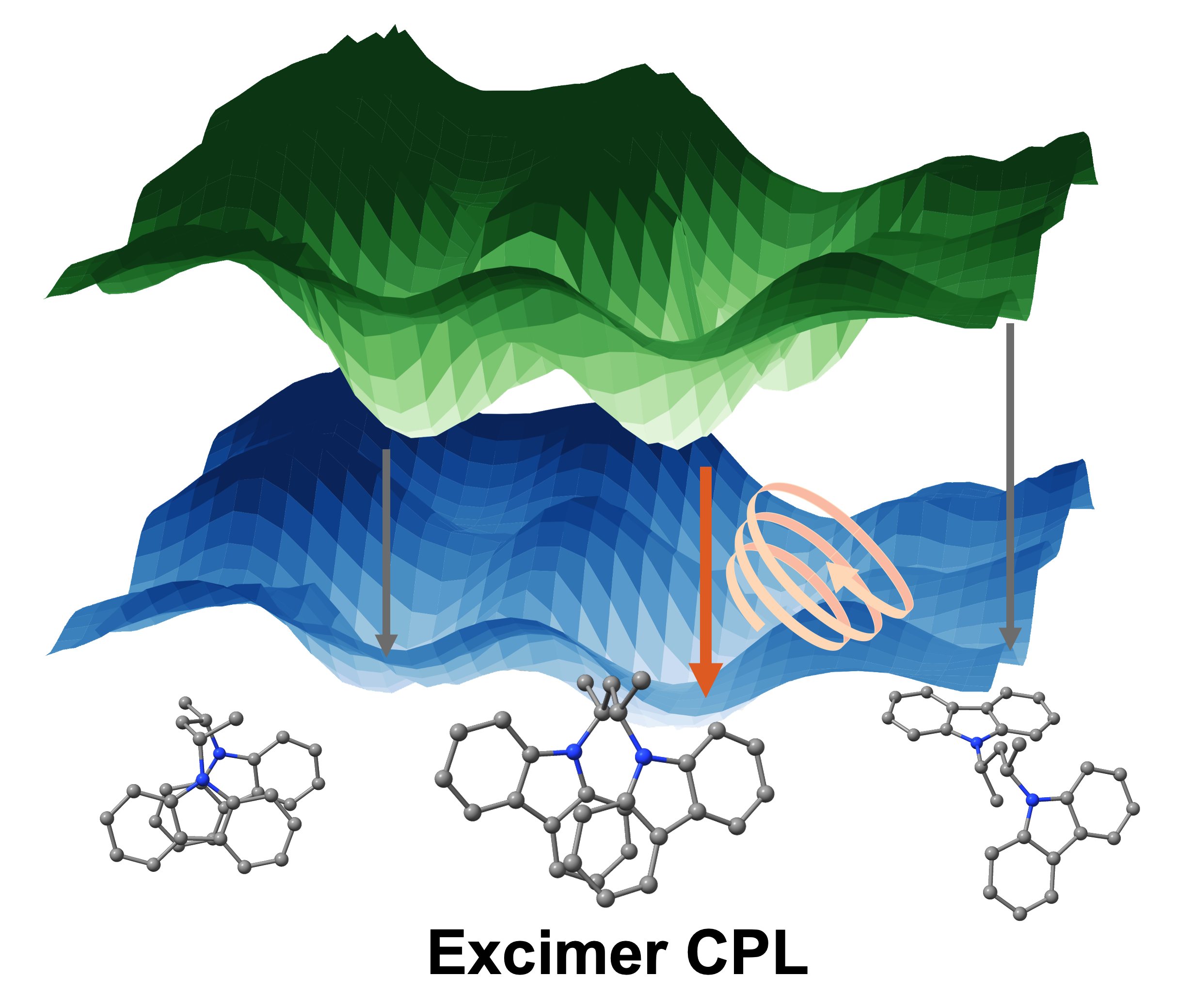
We demonstrate that in chiral carbazole dimers, the tt conformer generates intense excimer CPL, while gauche rotamers yield only local emission. In 1a, CPL intensifies and red-shifts upon cooling due to greater tt contribution. In contrast, the tert-butyl derivative 1b shows weak, temperature-insensitive CPL owing to enhanced accessibility of non-CPL-emissive gauche conformers. This work reveals how subtle substituent and environmental effects modulate excited-state conformational dynamics and chiroptical responses through a thermodynamic–kinetic interplay.
@article{kujime2026conformational,title={Conformational landscapes in the ground and excited states dictate circularly polarized excimer emission: A thermodynamic–kinetic interplay in carbazole dimer systems},author={Kujime, Tomohiro and Wang, Zhe and Mori, Tadashi},journal={Angew. Chem. Int. Ed.},volume={65},pages={e6661486},year={2026},month=apr,publisher={wiley},doi={10.1002/anie.6661486},url={https://doi.org/10.1002/anie.6661486},dimensions={true},tab={paper}}